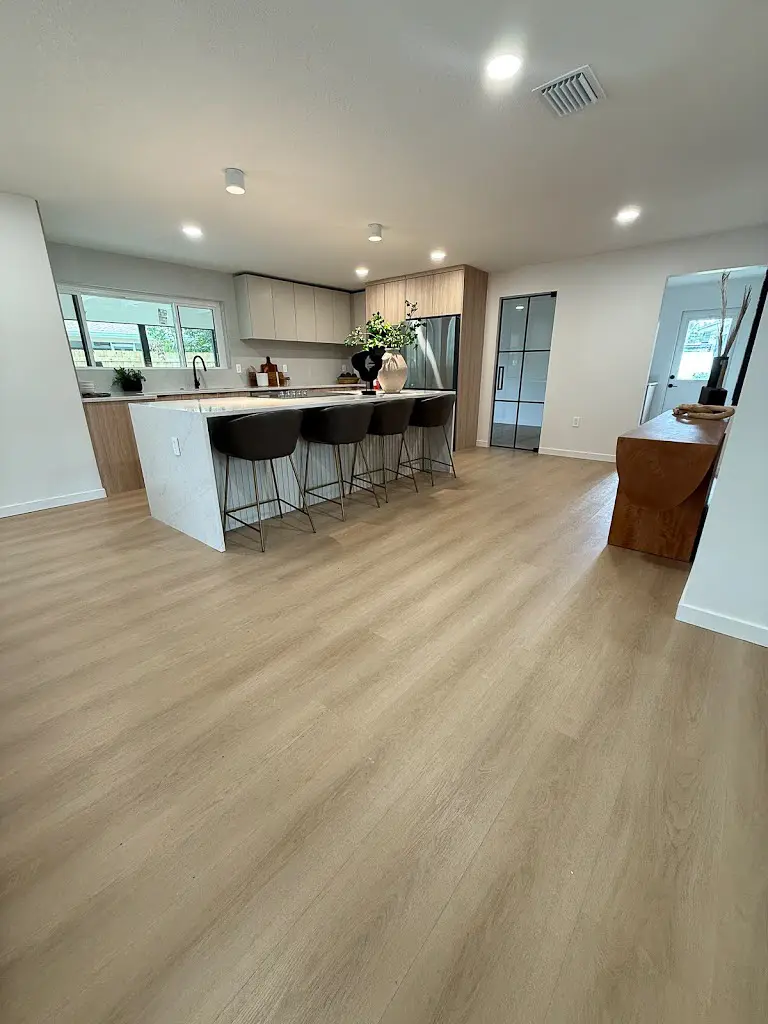
If you are replacing floors in a Tampa Bay home, luxury vinyl plank (LVP) and laminate will probably end up side by side on your shortlist. They look alike from across the room, both click together as floating floors, and both are made to look like wood. Underneath, they are very different products, and in a house built on a concrete slab in a humid climate those differences matter.
This guide covers what each floor is made of, how each one handles water and humidity, and where we usually suggest one over the other.
What is the difference between LVP and laminate?
Luxury vinyl plank is a layered floor. A printed wood or stone visual sits under a clear wear layer, and below that is a rigid core. Most of the LVP we install has a stone-polymer or similar rigid core, which does not absorb water.
Laminate is also layered, with a printed image under a hard, clear top surface. The difference is the core. Laminate is built on a high-density fiberboard core, which is a wood-based product. It is dense and stable, and it gives laminate a firm, solid feel underfoot, but wood fiber can swell if water gets into it.
Both are floating floors. The planks lock to each other rather than being nailed or glued to the slab, which is why both go down well over the concrete most Tampa Bay houses are built on.
Is LVP waterproof and laminate only water-resistant?
That is the short version, and it is mostly right.
A waterproof core means a spilled glass of water, a wet dog or a dripping dishwasher will not make LVP planks swell. You wipe it up and move on. Laminate has improved a lot, and many newer products resist surface spills for a period of time, but if water sits on the seams or gets under the floor, the fiberboard core can swell at the edges. Once a laminate plank swells, it does not go back.
What neither floor can do is stop water that comes from underneath. A slab leak, a burst supply line or storm water coming through the door will get under any floating floor, and the slab has to dry out before anything goes back down. LVP planks tolerate that kind of soaking far better than laminate does. That is one reason many homeowners near the water, especially after the 2024 storms, now ask for waterproof-core LVP or tile on the ground floor. No floor makes a house flood-proof, but some recover from water much better than others.
How does Florida humidity affect each floor?
Humidity is the other half of the Florida question. For much of the year the air is warm and damp, and the slab under your house can carry moisture up from the ground.
LVP is largely indifferent to humidity. It does not cup or gap as the seasons change, as long as it was installed with the expansion space the manufacturer calls for.
Laminate is more stable than solid wood, but its wood-based core still responds to moisture over time. Over a slab it always needs a moisture barrier underneath, either built into the underlayment or installed as a separate layer. With that barrier in place and the air conditioning running at normal settings, laminate performs well in Tampa Bay homes. Without it, you are asking a fiberboard core to sit on damp concrete.
For both floors, we check the slab for moisture before anything goes down. You can read more about that step in our guide to what happens to your slab before new flooring.
Which rooms suit LVP and which suit laminate?
Most homes do not need one floor for every room. Here is how we usually think about it.
When laminate makes more sense
Laminate is not the lesser choice. In the right rooms it is often the better one.
- Bedrooms, living rooms and home offices, where water rarely sits on the floor.
- Homes with big dogs, because a good laminate has one of the hardest, most scratch-resistant wear surfaces of any residential floor.
- Rooms where you want a firm, solid feel underfoot.
- Projects where budget matters, since laminate usually costs less than hardwood for a similar wood look.
If those describe the rooms you are doing, our laminate installation page goes further into products and installation.
When LVP is the better choice
We usually point people to LVP for the rooms where water actually happens.
- Kitchens, full bathrooms and laundry rooms.
- The floor by the pool door or the lanai slider.
- Ground-floor rooms in flood-prone or low-lying areas.
- Long, continuous runs through the main living area where you want one floor everywhere, kitchen included.
It is also a good fit for busy households with kids and pets, because the surface is easy to clean and does not mind a damp mop. Our luxury vinyl plank installation page explains how we lay it out and finish the edges.
Mixing LVP and laminate in one house
Yes, and plenty of homes end up with both: LVP in the kitchen, baths and laundry, laminate in the bedrooms. The key is planning the transitions so they look intentional. We pick products with tones that sit well together, place the change at a doorway rather than in the middle of a room, and keep the height difference as low as possible so there is no trip point.
Does the slab matter for LVP and laminate?
Whichever you choose, the slab decides how the floor will feel. Both LVP and laminate need a surface that is flat within the manufacturer's tolerance. If the slab has dips or ridges of old thinset, a floating floor will flex as you walk on it, and the locking joints can loosen or click over time. That hollow, clicky sound people complain about is usually a slab problem, not a plank problem.
That is why we treat floor removal and slab prep as part of the install. The crew that tears out your old tile or carpet is the same crew that grinds, levels and installs, so the prep does not get skipped.
How to decide between LVP and laminate
A simple way to think about it:
- If the room sees water, choose LVP.
- If the room is dry and you want the hardest surface or the best value, look closely at laminate.
- If you are unsure, compare both samples side by side in the room itself.
That last point matters more than it sounds. A plank that looks warm in a store can look gray next to your cabinets. We bring both LVP and laminate samples to your home so you can see them in your own light, as we explain in our guide to choosing flooring with samples at home.
If you are weighing LVP and laminate for a Tampa Bay home, book a free in-home estimate. We will look at the slab, talk through each room, and give you a clear quote for the whole job, from tear-out to trim.